My name is Travis Patron and I am an amateur practitioner of the Cree (Nēhiyawēwin) language.
I practice this language because I believe it is important for Canadians to pay homage to the languages native to this land.
Many of these Indigenous languages are in danger of becoming obsolete because they are not being socially supported.
As a candidate for public office, it is important to use these languages because there is historical knowledge encoded in them. When we lose a language, we lose the memories that accompany the natural history of that people. The stories that grounded the culture and gave the people a sense of purpose and identity fade away with the language when it is forgotten.
I speak a little Cree. I am still learning and not an expert by any means. However, I enjoy the challenge of learning a new language.
The experience can also be fun because it allows a person to immerse themselves in a new culture. Languages literally define culture. If a person desires to live in a culturally different way, they must speak a different language.
When we speak a new language, the way the world responds to us changes with it because the way we make sense of the world and attempt to understand society is through the spoken word.
When the words we use change, so too does the world around us. Words build worlds. Words materialize.
Unfortunately, it seems not everyone supports my efforts to learn such native languages. Shortly after delivering the following presentation on the Cree language at the University of Saskatchewan, I was inexplicably banned:
This is a CREE 110 presentation given before the White Buffalo Man on Friday, May 12th, 2023 at the University of Saskatchewan.
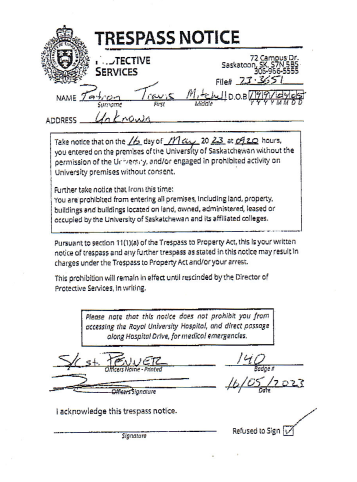
Despite being issued a trespass notice by Protective Services, I returned to campus a few months later and was accused of impersonating a peace officer (section 130(1)(a) CC.) when I did so. However, this criminal proceeding (information #991239849) does not preclude the Crown’s own liability under section 430(4.101)(b) of the Criminal Code which they incurred for interfering with my enjoyment of the University of Saskatchewan:
“Everyone commits mischief who wilfully interferes with any person in the lawful use, enjoyment, or operation of a building, structure, or part of a building or structure that is used primarily by an identifiable group as defined in subsection 318(4) CC. as an educational institution – including a university – or an object associated with that institution located on the grounds of such a building or structure.”
Section 430(4.101)(b), Criminal Code
The subsequent ticket from disregarding this trespass notice (ticket #85560322) was stayed by the Crown before I could speak to it, essentially prejudicing my defense in matters where Saskatchewan convicted me of impersonating a peace officer (information #991239849).
These proceedings were conducted by the University of Saskatchewan Protective Services in response to my attempt to nationalize the University and I have yet to be given an opportunity to speak in my defense regarding them.
Therefore, I reserve my section 11(b) Charter right to be tried within a reasonable time for allegedly failing to comply with the trespass notice (ticket #85560322).
Because justice is a balancing act, the court of law often conducts a test of proportionality in order to ensure that both parties involved are rewarded/punished fairly.
For every transgression, there is an appropriate remedy. For every wrong, there is a corresponding right. And where the court administering the affair prejudices either side, there is a higher court to which an appeal may be brought.
The law can be thought of as a moving target where the customs of the court follow the particular jurisdiction it operates in. What works in one locale may not work in another.
In Saskatchewan, the Crown can only proceed against citizens in good faith and without deceit (Clause 63, Magna Carta):
Application of Criminal Law of England “The criminal law of England that was in force in a province immediately before April 1, 1955 continues in force in the province except as altered, varied, modified or affected by this Act or any other Act of the Parliament of Canada.”
Section 8(2), Criminal Code
However, they have recently violated this understanding …
On August 2nd, 2023, I was a legal resident of Saskatoon. On that day, the Saskatoon Police Service (SPS) attended my apartment claiming they had a warrant for my arrest, and that if I didn’t open the door, they’d “knock it in”:
“We have a warrant for your arrest.”
SPS Constable Heather Primeau (#727), 241 5th Avenue N in Saskatoon on August 2nd, 2023 9:43 AM
Shortly thereafter, they broke and entered the property, thereby committing a home invasion:
Aggravating circumstance — home invasion If a person is convicted of 348 in relation to a dwelling-house, the court imposing the sentence on the person shall consider as an aggravating circumstance the fact that the dwelling-house was occupied at the time of the commission of the offence and that the person, in committing the offence, (a) knew that the dwelling-house was occupied; and (b) used threats of violence to property.
Section 348.1, Criminal Code
SPS Constable Kevin Sanderson (#884) broke and entered my apartment on August 2nd, 2023.
Weidner Apartment Homes Apartment #502 located at 241 5th Avenue North in Saskatoon was broken into on August 2nd, 2023.
Entrance “For the purposes of sections 348 and 349, a person enters as soon as any part of his body or any part of an instrument that he uses is within any thing that is being entered; and a person shall be deemed to have broken and entered if he obtained entrance by collusion with a person therein”
– Section 350, Criminal Code
However, during trialconducted voir dire on May 6th, 2024, the Saskatoon Police Service testified that they had no warrant in the matter.
That type of threat to my property, combined with them breaking and entering the apartment, is enough to nullify any claim that my actions were not the result of oppressive circumstances.
Without a warrant, the Saskatoon Police Service had no right to conduct themselves the way they did.
I was led to believe that the SPS was executing an arrest warrant, a warrant that, after hearing testimony from SPS Detective Sergeant Tracy Shepherd (#556, Hate Crimes Unit), didn’t exist.
Saskatoon Police Service (SPS)
I surrendered myself into their custody under duress and reserve a common law defense in relation to these proceedings for doing so:
Common law principles continued “Every rule and principle of the common law that renders any circumstance a justification or excuse for an act or a defence to the charge continues in force and applies in respect of proceedings for an offence under this Act or any other Act of Parliament except in so far as they are altered by or are inconsistent with this Act or any other Act of Parliament.”
Section 8(3), Criminal Code of Canada
On May 6th, 2024, I cross-examined Saskatoon peace officer Heather Primeau about this, who swore an oath to tell the truth, then immediately proceeded to testify falsely against me under that oath. She claimed to have “never” threatened to knock in my door, but I know otherwise …
“Thou shall not testify falsely against thy neighbor”.
Exodus 20:16
The Saskatoon Police Service (SPS) has proceeded in this matter mala fide (in bad faith).
Therefore, on August 29th, 2024, I made an application before Justice MacMillan-Brown to quash the warrant of committal (order #95300896) in furtherance of my right to a fair trial in the matter. Pursuant section 778(c) of the Criminal Code, a common law writ of certiorari is sufficient to quash the warrant of committal on the grounds that the omission to provide a fair trial in the matter has been the cause of persecution.
The Justice presiding dismissed that application. Instead, their fiat order dated September 2nd, 2024 insults my ability to communicate this grievance …
Because of Saskatchewan’s superior court dismissing this application, the innocent blood of a political party leader has been spilled … and a weapon was used to do it.
That’s the real crime …
The prosecution related to this information was political in nature as none of the allegations were violent. Rather than being about public safety, these proceedings have been adversarial to Canadian nationalism.
There is a war of deception being waged against our nation. The intention is to transition Canada into the “world’s first post-national country”. In order to do so, the Crown is effecting an unwarranted demographic change of our founding population, predominantly through immigration policy to which there exists no democratic mechanism to alter.
As described in section 13 of the Crimes Against Humanity & War Crimes Act, obedience to de facto authority is no justification here …
Conflict with internal law Despite section 15 of the Criminal Code, it is not a justification with respect to political persecution that the offense was committed in obedience to or in conformity with the law in force at the time and in the place of its commission.
Section 13, Crimes Against Humanity & War Crimes Act