Categories
Judicial

“Free & Democratic Society”

In their charge to the jury on October 5th, 2022, Court of King’s Bench for Saskatchewan Justice Neil Robertson cited Canada as a “free and democratic society”.

4 years have passed since those charges were laid on February 14th, 2021 under section 319 of the Criminal Code and I have yet to receive even a copy of the criminal complaint submitted to the Crown in the matter.

By withholding such access to personal information, the Crown has exceeded the reasonable limits demonstrably justified in a free and democratic society (section 1 of the Charter).

On April 16th, 2021, the Crown used this information to deny myself bail, and subsequently, de-register the Canadian Nationalist Party.

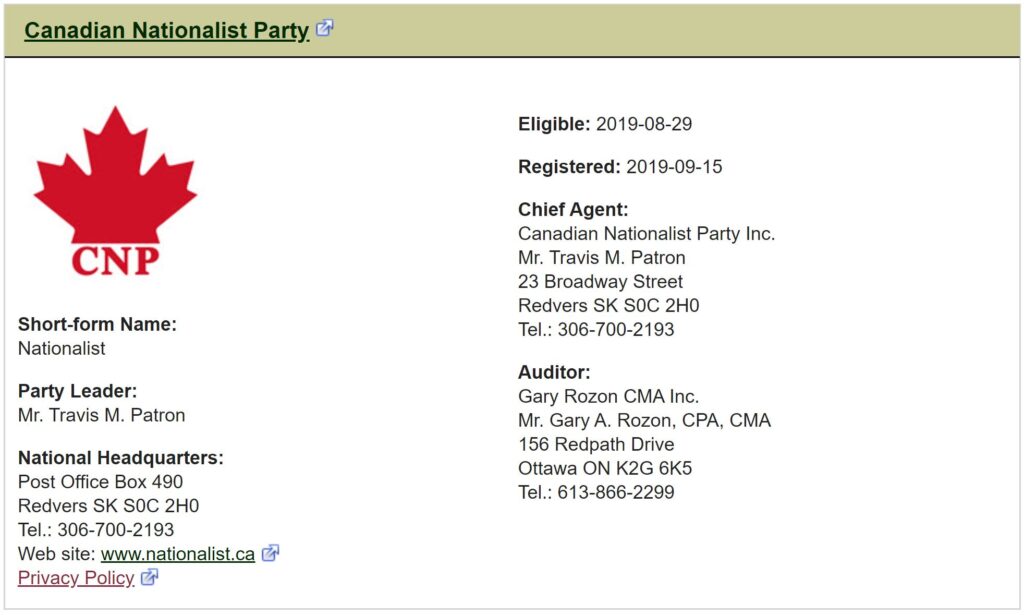
The Canadian Nationalist Party was registered by Elections Canada on September 15th, 2019, shortly after confirming their first candidate in the 43rd Federal Election. It was later de-registered by Elections Canada on March 31st, 2022 while Travis Patron remained arbitrarily imprisoned at the Regina Provincial Correctional Center (RPCC).

In June of this year, the Federal Court refused our right to access this information and I have now made an appeal to the Supreme Court to determine the validity of imprisonment following Justice Hind’s April 16th, 2021 decision to apply a reverse onus on the accused to “show cause” why they should be granted bail.

I reserve my right of habeas corpus ad subjiciendum pursuant section 784(3) of the Criminal Code in order to avoid an apparent conflict of interest that has arisen between the nationhood of Canada and the Province of Saskatchewan (section 35.1, Supreme Court Act).

This withholding of information used to apply a reverse onus has not been done for the sake of our national interests, but to advance a political objective of transitioning Canada into the “world’s first post-national country”. Therefore, I am making representations to the Crown that it be disclosed to the accused.

We originally made this application to the Supreme Court on October 1st, 2024 in accordance with the sessions of that court (section 32, Supreme Court Act).

Very real risk to public safety …
“The fear that sensitive information may ultimately be disclosed may lead our intelligence agencies to decide not to share it with law enforcement, with a corresponding and very real risk to public safety”

Senator Marc Gold on the use of secret intelligence in Canadian courts

It’s time for Canada to embark on a discovery of what information exactly was used to deprive our nation of its right to electoral democracy.

After refusing us access to the information requested, the burden lies with the Crown to prove that it has not been used to violate our nation’s right to a “free and democratic society”, and unless the Crown can prove this, the religious sermon entitled Beware The Parasitic Tribe will remain public on this here website.

As trier of fact, the Canadian public has the right to examine this propaganda as evidence in the claim that it is protected under Article 4 of the Treaty of Paris:

“His Britannick Majesty, on his side, agrees to grant the liberty of the Catholick religion to the inhabitants of Canada: he will, in consequence, give the most precise and most effectual orders, that his new Roman Catholic subjects may profess the worship of their religion according to the rites of the Romish church, as far as the laws of Great Britain permit.”

– Article 4, Treaty Of Paris (February 10th, 1763)

This speech was originally published in June of 2019, and for over 18 months following, Richard Warman of the Canadian Anti-Hate Network filed criminal complaints with the RCMP under the false presence that it is ‘Jews’ I am referring to as parasites (despite my consistent refutations).

The Canadian Anti-Hate Network has received hundreds of thousands of dollars in financial grants from the federal government and has used these grants to file criminal ‘hate speech’ complaints against political candidates under the false pretense of “combating anti-semitism”:

False Pretences
“Every one commits an offence who knowingly makes, directly or indirectly, a false statement in writing with intent that it should be relied on, with respect to the financial condition of any organization that he acts for, for the purpose of procuring, in any form whatsoever beneficial to that organization, the granting of credit;”

– Section 362(1)(c)(iv), Criminal Code

And so while organizations such as B’nai Brith might cry victim while lashing out, the propaganda in question enjoys immunity from prosecution by way of our Roman Catholic right as enshrined in treaties binding on the Crown.

If Canada is truly a “free and democratic society”, then it will hear the appeal we have made to the Supreme Court in addition to diplomatic immunity from any prosecution related to occurrence #2019-919038.

Categories
Judicial

Application for Leave to Appeal Information #991240166

On July 4th, the accused (myself) submitted an application to the Supreme Court of Canada for leave to appeal information #991240166 (filing confirmation #2025-07-bne-z7t).

The charges under the information include an alleged breach of Criminal Code sections 264 (criminal harassment) and 733.1 (failure to comply with probation order).

On September 5th, 2023, Justice Penner of the Provincial Court of Saskatchewan ordered a publication ban on the identity of the complainant.

At trial on January 16th, 2024, the Court refused to disclose to the accused evidence used by the Saskatoon Police Service (SPS) to lay charges under the information.

During sentencing submissions on February 2nd, 2024, the trial judge (Justice Morrall of the Court of King’s Bench) cited section 718.2(a)(i) CC. to impose a more severe sentence against the accused, claiming their actions at the scene were motivated by hate.

On September 19th, 2024, Saskatchewan dismissed the appeal of the accused while they were still in custody at the Regina Provincial Correctional Center (RPCC).

Today is Wednesday, July 30th and the accused awaits word from the Court in furtherance of the application for leave to appeal being scheduled for hearing.

Categories
Judicial

75 Maxims Of Canadian Law

This is a list of latin maxims I gleaned from studying The Dictionary Of Canadian Law by Daphne Dukelow (3rd Edition). I am reproducing them here as I believe they are relevant to political life in Canada today and can help secure our future as a unique nationality.

This list is by no means exhaustive. There may be additional maxims of Canadian law that have not be included here.

The list is as follows:

  1. prior tempore potior jure – The person first in time is preferred in right.
  2. testes ponderantur, non numerantur – witnesses should be weighed, not numbered.
  3. jus non patitur ut iden bis solvatur – The law does not require a second payment for the same thing.
  4. juris effectus in executione consistit – The effect of law is given by execution.
  5. jura publica anteferenda privatis – Public rights should be preferred over private rights.
  6. volenti non fit injuria – To a willing person, injury is not done.
  7. judicium a non suo judice datum nullius estmomenti – A judgement given without proper jurisdiction has no effect in law.
  8. melius est petere fontes quam sectari rivulos – It is better to go to the source than follow tributaries.
  9. mentio unius exclusio alterius – To mention one thing is to exclude another.
  10. minatur innocentibus, qui parcit nocentibus – Whoever spares the guilty threatens the innocent.
  11. multa concedunter per obliquum, quae non concedunter de directo – Many things are permitted indirectly which are not permitted directly.
  12. fatetur facinus qui judicium fugit – One who flees judgement admits guilt.
  13. lex prospicit non respicit – The law looks forward, not backward.
  14. lex uno ore omnes alloquitur – The law addresses all parties with a single voice.
  15. lex est dictamen rationis – Law is the pronouncement of reason.
  16. leges extra territorium non obligant – Laws are not binding outside their own territory.
  17. judices non tenentur exprimere causam sententiae suae – Judges are not required to explain the reason for their decisions.
  18. nemo reus est nisi mens sit rea – No one is guilty unless they have a guilty mind.
  19. quot homines tot sententiae – There are as many opinions as there are people.
  20. quod nullius est id ratione naturali occupanti conceditur – What belongs to no one is by natural right granted to its occupier.
  21. rerum suarum quilibet est moderator et arbiter – Each person is manager and judge of their own affairs.
  22. non est regula quis fallet – A rule does not exist without exceptions.
  23. quod ab initio non valet in tractu temporis non convalecit – What does not go well from the beginning will not improve with the passage of time.
  24. res judicata pro veritate accipitur – Until reversed, a judicial decision is conclusive and its truth may not be contradicted.
  25. nemo patriam in qua natus est exuere nec ligeantiae debitum enjurare possit – No one can cast away the country where they were born, nor foreswear the allegience owed to its sovereign.
  26. nihil habet forum ex scena – The court has no concern for things which are not before it.
  27. eodem ligamine quo ligatum st dissolvitur – An obligation is ended the same way in which it was imposed.
  28. qui vult decipi decipiatur – Let the one who wants to be deceived be deceived.
  29. non jus, sed seisina, facit stipitem – Not right, but seisin, makes the family tree.
  30. os demonstrat quod cor ruminator – The mouth divulges what the heart is thinking.
  31. multitudo errantium non parit errori patrocinium – That many people make the mistake does not excuse the error.
  32. respiciendum est judicanti, ne quid aut durius aut remissius constituatur quam causa deposcit; nec enim aut severitatis aut clementiae gloria affectanda est – The one who judges should be mindful that nothing either more severe or more lenient is done than the case merits; for distinction should not be achieved by either severity or leniency.
  33. ignorantia juris non excusat – Ignorance of the law is no excuse.
  34. illus quod alias licitum non est necessitas facit licitum; et necessitas inducit privilegium quod jure privatur – Necessity permits what otherwise is not permitted; and necessity establishes a privilege which is justly removed.
  35. clam deliquentes magis puniunter quam palam – Those who sin secretly are punished more severely than those who sin openly.
  36. arma in armatos sumere jura sinunt – To use arms against persons who are armed is justifiable.
  37. judicia in deliberationibus crebro maturescunt, in accelerato processu nunquam – Judgements often ripen through deliberation, never in a hurried process.
  38. invito beneficium non datur – A benefit is not given to anyone who did not ask for it.
  39. actor sequitur forum rei – A plaintiff must take the case to the defendant’s jurisdiction.
  40. majus dignum trahit ad se minus dignum – The more worthy brings the less worthy along with it.
  41. crescente malitia crescere debet et poena – Where malice increases, punishment should also increase.
  42. cujus est dare ejus est disponere – The one who gives something can also control its disposition.
  43. debile fundamentum fallit opus – A weak foundation destroys the work.
  44. dies dominicus non est juridicus – The Lord’s Day (Sabbath) is not a day for business (Lord’s Day Act).
  45. libertas est naturalis facultas ejus quod cuique facere libet – Freedom is the power given by nature to do whatever one pleases.
  46. longa possessio parit jus possidendi et tollit actionem vero domino – Prolonged possession creates a right of possession, and removes any right of action from the real owner.
  47. justitia nemini neganda est – Justice should be denied to no one.
  48. melius est omnia mala pati quam malo consentire – It is better to endure all evil than to agree to evil.
  49. in his quae de jure communi omnibus conceduntur, consuetudo alicujus patriae vel loci non est alleganda – In those things which common right concedes to all, the custom of a particular country or place should not be brought forward.
  50. jus descendit, et non terra – Right descends, and not the land.
  51. in judicio non creditor nisi juratis – In trial, no one’s evidence is accepted unless that person is sworn.
  52. jus non habenti tute non paretur – It is safe to disobey one who has no legal right.
  53. justitia debet esse libera – Justice should be free.
  54. vir et uxor consentur in lege una persona – Husband and wife are held to be one person in law.
  55. vigilantibus subvenit lex – The law helps the vigilant.
  56. vim vi repellere licet, modo fiat moderamine inculpatae tutelae – It is legal to repel force with force, as long as it is governed by a desire to defend.
  57. vox emissa volat, litera scripta manet – The spoken word disappears, the written word remains.
  58. rex non potest peccare – The monarch can do no wrong.
  59. legatus regis vice fungitura quo destinatur et honograndus est sicut ille cujus vicemgerit – An ambassador takes the place of the monarch who sent them and should be honoured just as the person in whose place they stand.
  60. jurare est deum in testem vocare, et est actus divini cultus – To swear is to call a deity to witness, and is an act of religious worship.
  61. vix ulla lex fieri potest quae omnibus commoda sit – Barely any law can be made which is applicable to everything.
  62. qui sentit commodum sentire debet etonus – The one who bears the burden should also reap the benefit.
  63. salus populi est suprema lex – The safety of the people is the highest law.
  64. quae non valeant singula juncta juvant – Words which have no effect alone are effective when combined.
  65. quod nullius est, est domini regis – What belongs to no individual belongs to the sovereign.
  66. quod necessarium est licitum – What is necessary is also lawful.
  67. impunitas semper ad deteriora invitat – leaving a crime unpunished invites worse crimes to be committed.
  68. electa una via, non datur recursus ad alteram – Having elected, recourse to the alternative is not permitted.
  69. donari videtur, quod nullo jure cogente conceditur – A thing is considered given when it is transferred any way except by virtue of right.
  70. error qui non restitur, approbatur – One who fails to rectify a mistake is deemed to have approved it.
  71. do ut facias – I give so that you may perform.
  72. nec veniam, effuso sanguine innocentis, casus habet – If innocent blood is spilled, the case is unforgivable.
  73. extra legem positus est civiliter mortuus – One placed outside the law is dead civilly.
  74. omne quod solo inaedificatur solo cedit – Everything built into the ground is merged with it.
  75. omnia quae jure contrahuntur, contrario jure pereunt – All things accomplished by a law come to naught with a contradictory law.